TBR-ia: August 19, 2026
This Week’s Wisteria:

Fewer color changes this time - I think that helped with the curling.
This Week’s Book:
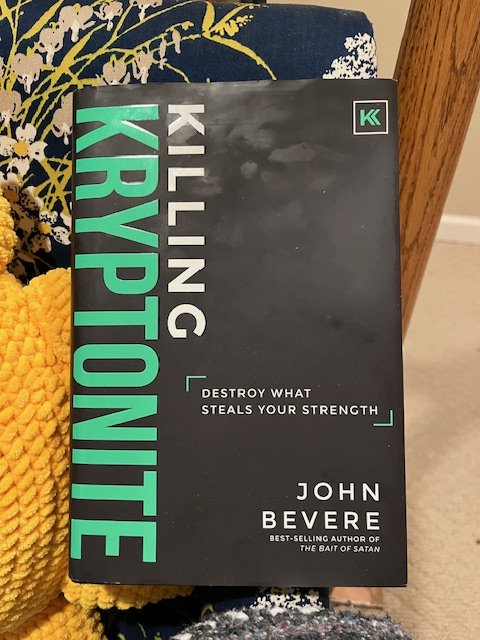
Killing Kryptonite, by John Bevere
Quick Summary: Christians are called to live lives empowered by God’s grace, and idolatry steals that power.
I have my TBR shelf organized in three sections: Fiction, General Nonfiction, and Spiritual. I have a habit of being in the middle of several books at once, and for probably over a year now, it’s usually been a minimum of one book from each TBR shelf category, plus occasional additional ones. (Like right now, I’m reading one book from each of those three sections, plus a fiction book in a fantasy compilation that I keep leaving and coming back to because the book is heavy, haha, plus a Bible study book that I started a few years ago and have restarted recently, plus an audiobook. I probably won’t include audiobooks in these blog posts, but I might discuss them separately somewhere. There have been some really great ones that I’ve listened to in the last few years!)
So, far all the books I have finished for this blog have been fiction. Today is our first one from the Spiritual section!
I am not super familiar with the author, John Bevere, I just know I have heard his and his wife’s names in the context of large, denominational Christian churches. With that, plus my background growing up in a church of Christ, I went into this book expecting to have some differences of opinion with Bevere but also hoping to be challenged. Boy, was I!
Some differences that I expected were there, but they were not the main focus of this book, so they actually didn’t come up much. (Differences like believing physical immersion (baptism) is a required part of conversion to Christianity (which I do), believing in Jesus coming to earth to reign for 1,000 years (which I not been convinced of), and believing that God uses blatant miraculous works in the world today (an idea I struggle with and have thought about more recently, actually).)
I can address those if needed, but I want to focus on some of the main points of the book in this post.
Some of those main points include:
Each of us in Jesus’ church is deeply connected to everyone else; one person’s sin can have a detrimental effect on others, physically and spiritually.
There is an additional emphasis on the overall attitude of the group, whether or not they are willing to address the sins of those in their number.
The early church was largely characterized by the power and Spirit of God being very present and active among the believers, which was seen by their communities.
Repentance and holiness are necessary in the life of a follower of Jesus and are what allows someone to have a deeply personal friendship with Jesus, not just be His servant.
Worldly sorrow focuses on self, on the consequences of sinful choices.
Godly sorrow focuses on the one harmed, especially God because all sin is ultimately against Him, and grieves over harming them.
Idolatry in the lives of believers robs them of the strength given to them by God to overcome sin.
Grace is not permission to continue in sin, but is actually the power God uses to enable His children to be victors over sin and their old ways of thinking.
Leaders (a term that can apply to any believer in some form, and even more so to those who lead within the body of Christ) should not only live in a way where they are walking with Christ personally, letting Him strengthen them to live as blamelessly as possible, but they should also speak out against sin and idolatry, especially any that is going on among God’s people.
Bevere has a chapter where he lists Old Testament kings and summarizes each one. He categorizes the better ones as either being ones who sought God in their personal life or ones who sought God in their personal life and tore down idols and instructed the people in God’s ways. There were significantly more blessings and praise connected with the second category of kings.
Believers are called to a totally transformed, radiant life that calls people out of the world and into God’s kingdom. The early church shook the world, and God has a pattern of saving the best for last. That was only the beginning and we are supposed to be participating and dwelling in that kind of awesome transformation.
Some quotes I appreciated:
“Have you privately questioned why so many believers in our churches today are weak, suffering from persistent sicknesses and diseases? […] Could it be the practiced sin of some is affecting the lives of many others?” (p. 32-33) (This part struck me, because I have thought about the first part more in the last few years.)
“We are called to be the triumphant church, the body of Christ that - no different than Jesus - is unstoppable!” (p. 42)
“A well-established pattern is seen throughout Scripture: God always saves the best for last.” (p. 71)
“Your relationship with God is your life - literally. There is no life outside of God.” (p. 93)
“The truest definition of true worship is not music or singing, but rather obedience.” (p. 96)
“We cannot properly serve unless we are content. Lacking this virtue will make us prone to view situations from the angle of how will this benefit me? Outward actions and words can appear unselfish or even self-denying, but if they are not founded in contentment, they will be fueled by self-serving motives.” (p. 108-109) (That one stepped on my toes!)
“A Christian engages in idolatry when he or she disregards what God has clearly revealed in order to obtain a strong desire. So, in essence, idolatry is known disobedience to the will of God.” (p. 125)
“When we are synchronized with God, we are in harmony with life itself.” (p. 130)
“[…] [grace] not only saves and forgives us, but also strengthens us to obey truth […] we can possess power, but if we fail to use it we won’t benefit from it.” (p. 144)
“It is impossible to have a deep, meaningful relationship with others who are selfish. God has given Himself fully to us; He cannot have us doing what the world does, using those we have relationships with to satisfy our own desires or ego.” (p. 172)
“Repentance certainly involves the mind but goes deeper; it involves our will and our emotions. It penetrates to the depth of our heart where we are firmly persuaded from the core of our being. […] This knowledge [about our actions/fruits being how we’re defined] alone illustrates the power of the gospel, for it contains the ability to change these innermost thoughts, thereby altering our conduct. To be truly impacted by the gospel isn’t a new way of thinking or an emotionally charged response, but rather a deep change of perception and belief accompanied by genuinely reformed behavior. Repentance occurs when we awaken to the truth and are fully persuaded to the core of our being that our philosophy or behavior is contrary to our Creator’s. “ (p. 194-95)
“We have to view life in an eternal context to comprehend true love.” (p. 239)
“There are some things God wants us to obey even when we don’t understand the why behind them. Can we believe He loves us when He tells us to stay clear of what seems good for us? Can His character be trusted? Or do we become the judges who tell Him what is good for us, no different than the couple did in the Garden of Eden?” (p. 242)
“If we speak the truth and yet are not kind and patient, but rather jealous, boastful, proud, rude, demand our own way, irritable, keep records of how we’ve been wronged, unforgiving, rejoice at injustice, and give up on people, we are not keeping His commandments. So we can preach repentance, faith in Jesus Christ, and all that is found in Scripture, but we are not operating in true love. We have entered into the realm of legalism and will hurt people, rather than bring them to God.” (p. 244)
(A response he says he gave to someone on how to truly operate in ministry) “‘The entire time you are bringing any form of correction or warnings, your heart burns in love for the people you are speaking to’” (p.244).
“Sorrow of the world focuses on us - What are the consequences? Will I be judged? Will I be disqualified? Will I suffer from my sin? What will people think of me? - and so forth. Godly sorrow focuses on Jesus; I’ve hurt the heart of the One I love, and no matter what He decides: His justice is fair and true and I fall before His mercy.” (p. 254)
“I realize most Christians see grace as salvation, forgiveness of sins, and an unmerited gift. But that is where it ends for the majority. I came to realize that God’s grace is all these amazing attributes, but it also empowers us to change, to do what truth calls us to do.” (p. 255)
“Before we ever did anything worthy of eternal value, God made a decision. He chose us, and in doing so, He declared us holy. We are without fault in His eyes. This is "positional holiness.” On the day we received Jesus, we became holy in God’s sight, and we will never be more holy.” (p. 269)
“Our behavior must reflect our position. […] I found out grace is God’s unmerited empowerment that gives us the ability to do what we couldn’t do in our own ability.” (p. 270)
“Friendship with Jesus is based on our genuine holiness, and those who make it a priority transcend from servant to friend status.” (p. 273)
“It’s a wonderful occurrence for both parent and child when a son or daughter graduates to becoming a friend. The same is true for the family of God. A change occurs in the relationship dynamic, as our Father lets us in on more secrets. But there’s a change for us as well. We now live more passionately not to disappoint Him, much beyond just not disobeying Him. We still, and always will, seek to obey, but it’s no longer our heart’s driving force. Not disappointing Him is. Holiness therefore is not an end in itself, as legalists portray it. It’s the entranceway to true intimacy with Jesus.” (p. 274)
Overall:
I was challenged to consider my own small thinking when it comes to God. He has the only true understanding of all things and alone knows what is best for each of us and what is possible. I was also encouraged to begin praying more as I used to, asking God for tenderness of heart and boldness.
I pray for myself, for John Bevere and his family, for each of you, that we don’t stop searching out the Truth, that we don’t let anything, even our own previous conceptions, get in the way of Truth and Love. Lord, reveal to us in Your good will and Your good timing the Truth, and sow in us the seeds of courage and love needed for us to walk the path before us and shine light along the way.
Wishing you goodness without end,
Jess